WHY NIGERIA KEEPS BLEEDING ON ITS ROADS AND HOW TO STOP THE BLEEDING.
By Olanrewaju Osho
1/4/20264 min read
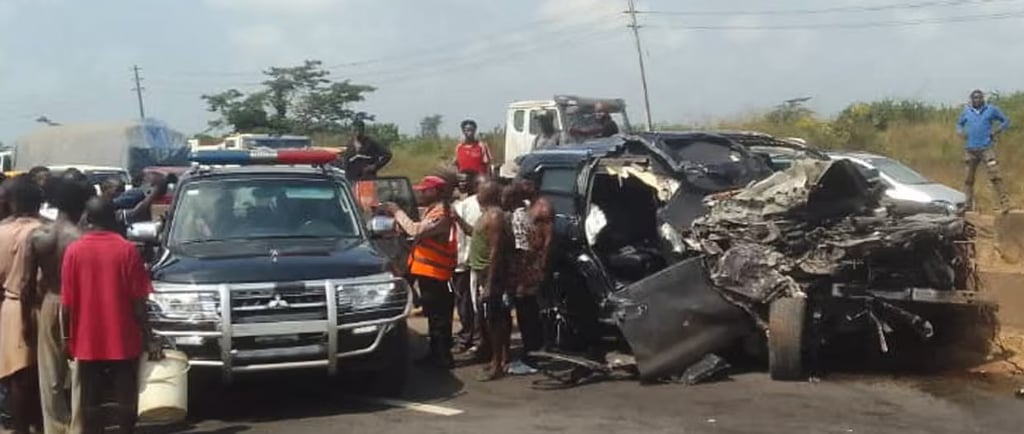
Every twenty-four hours in Nigeria, some families are torn apart by road crashes that never trend, never provoke outrage, and never result in reform. Fathers leave home and do not return. Mothers die on routine journeys. Children are buried without investigations or explanations. These deaths have become invisible because the victims are ordinary Nigerians.
Road safety only becomes a national conversation when a celebrity, billionaire, or powerful politician is involved. This selective empathy is not only tragic—it is dangerous. It explains why Nigeria continues to lose over ten thousand citizens every year to preventable road crashes, quietly and consistently.
This is not the work of fate. It is the outcome of policy failure, institutional weakness, and a profound disregard for human life.
ROAD SAFETY IS A GOVERNANCE ISSUE, NOT A SLOGAN
While governments bear statutory responsibility for road infrastructure and regulation, no country has ever reduced road deaths through government action alone.
Road safety is a multi-sector governance challenge.
Successful road safety systems are built on deliberate collaboration among:
• Federal, state, and local governments
• Road safety and law enforcement agencies
• Engineering and construction firms
• Transport unions and professional bodies
• Insurance companies and emergency medical services
• Media organizations and civil society
• Individual road users
Nigeria’s crisis persists because this ecosystem barely functions as a system. Most agencies with oversight on road safety issues prefer to operate in silos rather than synergize.
THE DANGER OF UNDERVALUING UNDERVALUES HUMAN LIFE
The persistent carnage on Nigerian roads reflects one grim reality: human life is cheap in our public policy calculations. This anomaly is rooted in societal attitude before it became embodied in public policy calculations.
It is evident in:
• Roads designed without safety margins or error-forgiving features
• Vehicles allowed on our roads without minimum safety standards
• Emergency response systems that arrive late or not at all
• Weak enforcement compromised by corruption and apathy
• Poor trauma care and post-crash management.
In societies that undervalue life, preventable deaths become routine—and accountability disappears.
ROAD CRASHES ARE NOT ACCIDENTS
The term “road accident” is misleading. Accidents suggest inevitability. Road crashes are predictable and preventable events caused largely by human behavior interacting with poorly designed systems.
Speeding, fatigue, impaired driving, unsafe vehicles, and flawed road design are measurable risk factors. Countries that manage these risks save lives. Countries that ignore them bury citizens.
THE 5 ES OF ROAD SAFETY: A PROVEN GLOBAL FRAMEWORK
Effective road safety management rests on five pillars: Engineering, Enforcement, Education, Emergency Response, and Evaluation. Every country that invests genuinely in building these pillars recorded downward trends in traffic fatalities within the shortest possible time. If Nigeria develops the hunger and courage genuinely build these pillars, it will see tremendous reduction in road traffic crashes injuries and death quickly and unfailing.
1. ENGINEERING: DESIGNING ROADS AND VEHICLES THAT FORGIVE HUMAN ERROR
Engineering is the foundation of modern road safety. It is built on a simple truth: humans will make mistakes, and safe systems must ensure those mistakes do not result in death.
Engineering does not end with asphalt and concrete. It includes road design, vehicle design, crashworthiness, and safety technology.
Safe roads are wide enough to forgive errors, equipped with shoulders, median barriers, clear signage, and proper drainage.
To reduce road crashes in Nigeria through road designs, all new roads must meet at least the three-star safety rating standard, while existing highways must be urgently upgraded. This requires strong policy direction and the elimination of corruption in procurement and supervision.
A good road is not only a smooth road. A good road is a safe road. A safe road is a road that incorporates all the elements of safety in its design and construction.
Equally critical is vehicle safety engineering. In countries that value life, vehicles are designed to protect occupants through:
• Reinforced safety cages and crumple zones
• Advanced braking and stability systems
• Lane assist and collision avoidance technology
• Multiple airbags—sometimes 12 or more—strategically placed to reduce fatal injuries
These features are not luxuries; they are life-saving systems.
This is also why responsible nations operate mandatory vehicle crash-testing and safety rating programs, such as Euro NCAP, IIHS, and ANCAP. These programs rigorously test vehicles and publicly rate their safety performance, forcing manufacturers to prioritize human life.
Nigeria has no functional national car crash-testing or vehicle safety rating program. As a result, vehicles that would fail safety tests elsewhere are freely imported and sold, often transporting entire families. This regulatory vacuum significantly increases the severity of crashes and the likelihood of death.
Engineering reform in Nigeria must therefore include:
• Enforcing minimum vehicle safety standards
• Establishing a national crash-testing and vehicle safety rating framework
• Regulating imported vehicles for crashworthiness
• Upgrading road infrastructure to meet global safety benchmarks.
Had Nigeria applied modern engineering standards to both roads and vehicles, many crashes—including the one involving Anthony Joshua—might have resulted in injuries rather than funerals. Engineering, when done right, does not eliminate crashes; it prevents deaths.
2. ENFORCEMENT: DETERRENCE SAVES LIVES
Speed is seductive, and indiscipline is deadly. Enforcement exists to restrain dangerous behavior.
Evidence shows that a 5% reduction in average speed can cut fatal crashes by up to 30%. Yet Nigeria’s enforcement regime is weak, inconsistent, and compromised.
Effective enforcement requires:
• Automated speed monitoring
• Radar-based patrols
• Clear penalties applied without bribery.
Without enforcement, traffic laws become mere suggestions—and lives are the price.
If the enforcement of speed governance along Lagos - Ibadan Expressway was as effective as it should be, Anthony Joshua's crash could possibly have been avoided.
3. EDUCATION: KNOWLEDGE THAT SHAPES BEHAVIOR
Road safety education is not literacy; it is behavioral conditioning.
Nigeria must reform:
• Driver training and licensing systems
• Road safety education in schools
• Continuous public awareness through media.
Ignorance on the road kills as efficiently as recklessness.
4. EMERGENCY RESPONSE: MINUTES DETERMINE SURVIVAL
The “golden hour” after a crash often determines life or death.
Nigeria urgently needs:
• A unified national emergency number that works for everyone
• Professionally staffed ambulance services
• Well-equipped trauma centers
• Strong public–private partnerships to scale response capacity
5. EVALUATION: LEARNING OR REPEATING FAILURE
No intervention succeeds without honest evaluation.
Every crash must generate lessons. Every policy must be measured. Every failure must be corrected.
Without evaluation, Nigeria will keep repeating the same mistakes—burying new victims each time.
THE BIG CHALLENGE
Road safety is not merely a technical issue. It is a moral issue as well. A nation that cannot protect its citizens on the road is a nation at war with itself.
Nigeria must decide whether its people are expendable—or priceless. The time to take that critical decision is now.
The next fatal road crash is preventable. But only if we replace indifference with intention, excuses with systems, and negligence with respect for human life.
Until then, Nigerian roads will continue to bleed.
Olanrewaju Osho promotes development and safety in Africa through Safety Beyond Borders and Inspire Nigeria Initiative.